Arkansas News

Jim Wallis Pledges More Than $100,000 to Elevate UAMS’ Bates Professorship to Endowed Chair

By Andrew Vogler

LITTLE ROCK — Jim Wallis, former president and CEO of ExOK Inc., pledged $102,948 towards the Joseph H. Bates III, M.D., M.S., Chair in Academic Public Health Practice at the University of Arkansas for Medical Sciences (UAMS). Wallis’ gift helped elevate the professorship to a fully endowed chair.

UAMS created the professorship in 2017 to recognize the accomplishments of Joseph H. Bates, M.D., M.S., and his dedication to public health in Arkansas, Wallis’ gift will expand the impact of the Dr. Bates’ significant work and legacy.

The chair’s work stems from the need for physicians to be educated in the discipline of public health to enable them to assume leadership roles in academic public health practice. The chair will support the teaching, research, service and other activities of an academic public health practice leader in the UAMS Fay W. Boozman College of Public Health in furtherance of developing a model of public health practice.

https://news.uams.edu/2023/02/16/jim-wallis-pledges-more-than-100000-to-elevate-uams-bates-professorship-to-endowed-chair/

Arkansas bill could regulate, criminalize librarians who harbor ‘obscene’ materials

KUAR | By Josie Lenora

A bill advanced by the Arkansas Senate Judiciary Committee Monday could criminalize library employees who “distribute obscene materials,” and require schools to create a committee to review challenged books.

Contrary to state law, Senate Bill 81 would also allow parents to look at their children's book checkout history. Republican Sen. Dan Sullivan, the bill’s sponsor, said he felt it was a common-sense measure.

“We don't let kids smoke we don't let kids drink, we don't let them drive,” he said. “This book seeks to add library material that's inappropriate to that list of things.”

https://www.ualrpublicradio.org/local-regional-news/2023-02-20/arkansas-bill-could-regulate-criminalize-librarians-who-harbor-obscene-materials

Chris Hickey/KUAR News

A bill advanced by a legislative committee Monday could put criminal penalties on librarians in Arkansas who provide "obscene" materials.

Sanders endorses enhanced penalties for drug dealers, traffickers

KUAR | By Daniel Breen

Arkansas Gov. Sarah Huckabee Sanders says she supports a new bill which would allow courts to sentence certain drug dealers to life in prison for causing an overdose death.

Sanders made the announcement Friday alongside Attorney General Tim Griffin and Senate Bill 283's Republican co-sponsors, Sen. Ben Gilmore, R-Crossett, and Rep. Jimmy Gazaway, R-Paragould. The governor said the enhanced sentences are necessary due to a nationwide spike in drug overdoses brought on largely by the synthetic opioid fentanyl.

“Arkansas will charge drug dealers with murder if they deliver drugs that cause an overdose. For the most heinous drug dealers, those who traffic fentanyl to children, we will charge them with life in prison. And for anyone caught trafficking fentanyl… Arkansas will put you in jail for 25 to 60 years and impose a mandatory $1 million fine,” Sanders said.

https://www.ualrpublicradio.org/local-regional-news/2023-02-17/sanders-endorses-enhanced-penalties-for-drug-dealers-traffickers

Daniel Breen/KUAR News

(From left) Rep. Jimmy Gazaway, R-Paragould, Attorney General Tim Griffin and Gov. Sarah Huckabee Sanders speak to reporters at the Arkansas State Capitol on Friday, Feb. 17, 2023.

Arkansas files suit after EPA rejects ozone plan

KUAR | By Steve Brawner / Talk Business & Politics

The state of Arkansas has filed suit against the Biden administration’s Environmental Protection Agency after the EPA rejected Arkansas’ submission for complying with a rule pertaining to ozone emissions affecting other states.

The lawsuit was announced Thursday (Feb. 16) by Gov. Sarah Huckabee Sanders and Attorney General Tim Griffin.

The EPA’s disapproval was published in the Federal Register on Feb. 13. The agency disapproved State Implementation Plan (SIP) submissions for 19 states for the 2015 rule regarding ozone national ambient air quality standards. State plans for Tennessee and Wyoming were partially disapproved.

https://www.ualrpublicradio.org/local-regional-news/2023-02-17/arkansas-files-suit-after-epa-rejects-ozone-plan

Wil Chandler/Arkansas Business

The White Bluff coal-fired power plant in Redfield, Ark. is seen in this file photo.

Controversial bills move forward in legislature

by Roby Brock (roby@talkbusiness.net)

State senators moved two controversial bills forward in the Senate Judiciary Committee on Monday (Feb. 20).

SB 199, by Sen. Gary Stubblefield, R-Branch, creates a “private right of action” allowing people to sue individual healthcare providers after receiving transgender medical treatment if they can prove “injury.” The bill was amended to shorten the period of time for a civil action to be filed from 30 years to 15 years. Senate Judiciary members, who have previously approved the bill, moved it forward again to the full Senate.

The majority of the committee’s time was spent debating SB 81, by Sen. Dan Sullivan, R-Jonesboro. His bill would create a system for local oversight of materials available at public and school libraries. On Monday, Sullivan amended his bill to remove language that he said would clarify if someone intentionally violated a decision made by a review board.

https://talkbusiness.net/2023/02/controversial-bills-move-forward-in-legislature/

Governor’s education bill filed with 25 GOP Senate, 55 GOP House sponsors

by Steve Brawner (BRAWNERSTEVE@MAC.COM)

Arkansas Gov. Sarah Sanders’ LEARNS Act was filed late Monday (Feb. 20) with enough sponsors to ensure passage.

The 144-page Senate Bill 294 by Sen. Breanne Davis, R-Russellville, has 24 co-sponsors along with Davis in the 35-member Senate and 55 co-sponsors in the 100-member House of Representatives. All the sponsors are Republicans. You can read the bill here.

It will be considered Wednesday (Feb. 22) in the Senate Education Committee.

https://talkbusiness.net/2023/02/governors-education-bill-filed-with-25-gop-senate-55-gop-house-sponsors/

The Supply Side: More retailers focusing on healthcare in 2023

by Kim Souza (ksouza@talkbusiness.net)

Retailers seem to agree that one sector that’s ripe for disruption is healthcare. Multiple companies are making moves to fill the gaps they see by investing in providing health and wellness services for their customers.

Scott Benedict, an executive at Rogers marketing agency WhyteSpyder, said healthcare is another battleground for retailers given the continued state of disarray in the sector. He said healthcare services are traffic drivers and also a way for retailers to provide solutions that their customers need and appreciate.

“There is a halo effect that can result from the pharmacy and health and wellness services provided by retailers,” Benedict said. “It can take time to profit from these services themselves, but with the customer loyalty you can build and trip occurrence, you can add to the profits and eventually support an extra revenue stream.”

https://talkbusiness.net/2023/02/the-supply-side-more-retailers-focusing-on-healthcare-in-2023/

Weekly Update from State Representative DeAnn Vaught

More than 70 bills have been signed into law since the 2023 Regular Session began and several more are now making their way to the Governor’s desk. 

In the 6th week of the session, the House passed bills addressing mental health access, payment to our county jails, teacher retirement, and voter input on tax measures.  

On Thursday, the House passed HB1181. This bill seeks to address a shortage of mental health professionals in the state by establishing the Counseling Compact in Arkansas. The compact allows professional counselors licensed and residing in compact member states to practice in other member states without the need for multiple licenses. 

That same day the House passed SB 72. This bill requires the Division of Correction to begin paying reimbursements to county jails for holding state inmates from the day the inmate is sentenced. Currently, reimbursements can start after the division receives commitment orders.  

Earlier this week, the House passed SB116. This bill would allow a classroom teacher that leaves active employment for a period of time and then returns back to employment, to purchase the gap years at actuarial cost with the Arkansas Teacher Retirement System. The purpose of this bill is to encourage experienced teachers to return to the classroom. 

The House also passed HB1027. This bill would require voter approval for any new advertising and promotion tax or any increase of existing advertising and promotion tax. Currently, this tax can be levied by county quorum courts. 

Other bills passing the House this week include the following: 

HB1006-This bill states that an employer that covers abortions or travel expenses related to abortions for employees shall provide 12 weeks of paid maternity leave to eligible employees. 

HB1334-This bill creates the Restroom Access Act. It requires retail establishments to allow access to employee restrooms for customers with certain medical conditions. 

HB1325-This bill states that if a county board of election commissioners decides to hold early voting at an additional polling site, the hours the additional early voting polling site is open shall be the same hours as the county clerk's designated early voting location. 

HB1307-This bill authorizes the State Treasurer to divest certain investments if financial providers discriminate against energy companies, firearms entities, or otherwise refuse to deal based on environmental, social justice, and other governance-related factors. 

The House will begin the 7th week of the session on Monday, February 20.

ServSafe Manager Training Class at UA Cossatot De Queen Campus

The Sevier County Extension Office will be offering ServSafe Manager Training in English on March 20th and Test will be on March 23rd from 9-12 in the Adams Building on UA Cossatot campus.. The class will be from 8:00 am to 6:00 pm. on the 20th. 

Registration deadline is March 10th. If you have any questions or would like to register, please contact the Sevier County Extension Office at 870-584-3013 or stop by our office located on the UA Cossatot campus in Adams Building in De Queen. You can also email me, Janet Cantrell at jcantrell@uaex.edu for more information.   Please make checks payable to Sevier County Extension.

UA Cossatot Chosen To Receive US Department Of Labor Grant Of Nearly $1.6 Million

FOR IMMEDIATE RELEASE: February 16, 2023

CONTACT: Loren Hinton, Community Relations Coordinator

UA Cossatot Chosen To Receive US Department Of Labor Grant Of Nearly $1.6 Million

WASHINGTON – The U.S. Department of Labor today announced the award of $50 million in grants to help 15 community colleges in 14 states expand access to education and training for good-paying jobs and equitably meet employers’ and workers’ skill development needs.

The funding announced today – together with the $45 million awarded in September 2022 – is a combined investment of $95 million since 2022 in the community college system from the Department of Labor under the Biden-Harris administration, allowing 28 community colleges in 24 states to provide career pathways for participants to train in healthcare, teaching, clean energy and other key industries.

In January 2023, the Bureau of Labor Statistics reported that full-time college graduates earn almost twice as much each week as workers with high school diplomas. For people in marginalized and underserved communities, a lack of access to education and training hinders career pathways and often worsens their economic disparities.

“Community colleges offer accessibility and affordability that make them great options for people in marginalized and underrepresented communities to learn the skills needed to succeed in the workforce,” said Secretary of Labor Marty Walsh. “Combined with our September 2022 funding, today’s award will put $95 million to work to help community colleges in 24 states tailor their curriculum to respond to regional labor market needs, continue the Biden-Harris administration’s commitment to investing in education programs that connect people to quality jobs, and create a more inclusive and equitable workforce.”

Upon the announcement of the grant, UA Cossatot Chancellor Dr. Steve Cole said, "This grant will mean 1.6 million dollars to our college to aid us in our ongoing effort to help hard-to-reach students succeed in certain education and medical programs. This is fantastic news for our college and our area!"

Administered by the department’s Employment and Training Administration, the third round of Strengthening Community Colleges training grants will enable recipients to increase educational and economic opportunities for people in underrepresented communities. Grants will provide opportunities to design and align education and training to respond to regional and state labor market needs through accelerated learning pathways.

In March 2022, the department announced funding availability for the second round of Strengthening Community College Training grants. A subsequent announcement – in June 2022 – made $50 million available for the round of funding awarded today.


Grant recipients include:


Cossatot Community College of the University of Arkansas

De Queen, AR $1,597,031


Los Angeles Community College District

Sylmar, CA$ 1,600,000


Arapahoe Community College

Littleton, CO $4,989,434


College of Central Florida

Ocala, FL $4,732,384


William Rainey Harper College

Palatine, IL $1,599,842

Des Moines Area Community College

Ankeny, IA $4,999,094


Minnesota State Community and Technical College

Fergus Falls, MN $4,201,050

County College of Morris

Randolph, NJ $1,600,000


Lorain County Community College District

Elyria, OH $5,000,000

Tulsa Community College

Tulsa, OK $1,600,000


Northeastern Technical College

Cheraw, SC $4,900,636


Piedmont Technical College

Greenwood, SC $4,987,461


Brazosport College

Lake Jackson, TX $1,598,762


Southside Virginia Community College

Alberta, VA $1,599,530


Chippewa Valley Technical College

Eau Claire, WI $4,994,776

Myth vs. Fact: Arkansas LEARNS

Myth: “Educational Freedom Accounts will hurt public education and close rural schools.”

FACT: Actually, the opposite is true. Research shows that Educational Freedom Accounts lead to better outcomes in traditional public schools. That’s because they empower parents of all incomes to customize their child’s education; if the local school district is the best option, it won’t lose any kids. Data from other states show that the large majority of families, when given the choice, continue to send their kids to traditional public schools and charter schools – but families deserve to have that choice.

Myth: “School choice programs give money to unaccountable private schools.”

FACT: Here in Arkansas, it’s not school choice; it’s parental empowerment. Ultimately, parents make the best decisions for their child and know when a school is right or wrong. Often that means sending kids to their local school district, but a child’s ZIP code shouldn’t be the only thing determining the type of education they receive. And any private school or student that opts into this program will be held accountable and required to participate in year-end assessments, just like students in traditional public schools.

Myth: “Critical Race Theory isn’t being taught anywhere in Arkansas.”

FACT: President Biden’s Department of Education is using nationwide guidelines and grant programs to force school districts to adopt key tenets of Critical Race Theory. That includes work from the “Abolitionist Teaching Network” and parts of the newly proposed “American History and Civics Education” priorities. The Governor’s Executive Order directed the Secretary to comb through those DOE materials to ensure Washington bureaucrats can’t bully Arkansas schools into teaching racist indoctrination. As Governor Sanders and Secretary Oliva have said, Arkansas will teach students how to think, not what to think.

Myth: “This gets rid of the teacher pay scale and discourages teachers from pursuing further education.”

FACT: This bill simply puts salary schedule decisions back in the hands of districts and won’t reduce any teacher’s pay one bit. The current statewide, one-size-fits-all approach doesn’t let administrators tailor their salary schedules to do what’s best for students.

Myth: “This will cost taxpayers far too much.”

FACT: This bill uses a mixture of existing state funds and federal grants to fund the price tag. In fact, Arkansas is still on track to enact another tax cut. And of course, quality education systems pay for themselves many times over in the long run. Every kid deserves the opportunity for a quality education that sets them up for a lifetime of success. 

Myth: “This bill forces every kid to go to government-run pre-k.” 

FACT: This bill does not mandate pre-k or government-run childcare. We simply want those programs to exist for the families who want and need them.

Myth: “Holding kids back won’t solve the problem and hurts low-income and minority children.” 

FACT: When only 35% of Arkansas third graders can read at grade level, we are doing struggling kids a disservice by allowing them to go to 4th grade without the tools to be successful. This bill gives them the resources to succeed, including reading coaches, tutoring grants, improved pre-k, better learning measurements, and parental notification systems.

Myth: “Community service requirements hurt low-income kids who work to help their families”

FACT: Education isn’t just about what you learn in the classroom; it’s also about preparing the next generation to contribute positively to their community. In certain circumstances, this plan also allows waivers in cases of family illness, homelessness, or when a child contributes to their family’s income.

Myth: “Your School Safety Plan contributes to the school-to-prison pipeline”

FACT: Parents know that putting law enforcement in schools makes kids safer, no matter what the Defund the Police crowd claims. This School Safety Plan pulls directly from the Arkansas School Safety Commission’s expertly crafted recommendations and puts student safety over partisan politics.

Myth: “This bill mimics Florida’s Don’t Say Gay Bill and discriminates against sexual minorities.”

FACT: Most Americans agree that young children shouldn’t be exposed to obscene sexual content in the classroom. Clearly, you haven’t read Florida’s bill, and you have not read this one. This bill isn’t radical or discriminatory – it’s about protecting kids.

Myth: “This plan unfairly gives new teachers a bigger pay bump than veteran teachers.”

FACT: This plan gives districts enough money to raise every teacher’s pay. It’s up to administrators to take steps to retain their employees.

Myth: “Paid maternity leave will cost the taxpayers too much.”

FACT: Districts can either opt into this program – and cover half of the costs – or opt out. When teachers have to quit their job just to have a family, it hurts both school performance and the taxpayer.

Myth: “Without protection, teachers will be fired unjustly.”

FACT: Nothing in this plan denies teachers access to due process if they have been terminated.  This simply allows districts to terminate teachers who do not perform up to reasonable standards.

Arkansas Bills Signed

LITTLE ROCK, Ark. — On Monday, February 13, 2023, the Governor signed into law:

HB1108, to modify the number of members of the Arkansas Dietetics Licensing Board that constitutes a quorum and that may call a special meeting; and to authorize use of email for renewal notices. 

HB1155, concerning the compliance of childcare facilities with local regulations when seeking licensure under the Childcare Facility Licensing Act. 

HB1178, to reduce the hours of training required for licensure of a community paramedic.

HB1042, to enhance coverage of prostate cancer screenings by health benefit plans.

SB6, to create a lifetime certificate of license as a contractor.

HB1200, concerning an inactive member’s eligibility for free military service credit and ability to purchase military, contributory, and federal service credit in the Arkansas Teacher Retirement System; and to declare an emergency.

HB1251, to clarify that criminal background checks apply to all emergency medical services personnel; and to amend the criminal background check law to include offenses prosecuted in other states or by federal courts.

HB1098, to clarify that a volunteer fire department may operate a newborn safety device under certain conditions under the Safe Haven Act.

HB1144, to create a specialty court program for families involved in a dependency-neglect proceeding that are affected by substance use disorders or mental health disorders.

HB1127, to create the Rural Emergency Hospital Act; to authorize the licensure of rural emergency hospitals by the department of health; and to declare an emergency.

HB1250, to amend the prescription drug monitoring program advisory committee; and to amend the confidentiality of and the providing of information by the prescription drug monitoring program.

HB1267, to require a specific number of hours of dementia training for home caregivers.

HB1164, to amend the law concerning the correction of errors arising from the erroneous sale of lands of the state of Arkansas; and to amend the law concerning the duties of the commissioner of state lands.

HB1202, to amend the law concerning the multiplier used to calculate a life annuity under the Arkansas Teacher Retirement System; and to declare an emergency.

HB1199, to permit a refund of unused purchased service credit under the Arkansas Teacher Retirement System; and to declare an emergency.

HB1184, to amend the law concerning the membership status of certain members of the Arkansas Teacher Retirement System; and to declare an emergency.

HB1183, to amend and update provisions for outsourcing under the Arkansas Teacher Retirement System; and to declare an emergency.

SB115, to amend and update the law concerning survivor annuity benefits under the Arkansas Teacher Retirement System; and to declare an emergency.

SB84, an act for the Department of Parks, Heritage, and Tourism – Capitol Zoning District Commission appropriation for the 2023-2024 fiscal year.

SB27, an act for the auditor of state – continuing education of local officials’ appropriation for the 2023-2024 fiscal year.

HB1060, an act for the office of the treasurer of state – general obligation bonds appropriation for the 2023-2024 fiscal year. 

HB1061, an act to make an appropriation for state turnback for counties and municipalities by the office of the treasurer of state for the fiscal year ending June 30, 2024, and for other purposes.

HB1066, an act for the office of the treasurer of state – amendment 74 property tax appropriation for the 2023-2024 fiscal year. 

HB1068, an act for the office of the treasurer of state – city-county tourist meeting and entertainment facilities assistance appropriation for the 2023-2024 fiscal year. 

HB1069, an act for the office of the treasurer of state – refund of local taxes appropriation for the 2023-2024 fiscal year.

HB1070, an act for the office of the treasurer of state – assistance to local law enforcement and emergency medical appropriation for the 2023-2024 fiscal year.

SB25, an act for the Department of Transformation and Shared Services – Arkansas Geographic Information Systems Office appropriation for the 2023-2024 fiscal year.

HCR1001, to urge Congress to permanently extend the Tax Cuts and Jobs Act of 2017.

SCR3, designating hypertrophic cardiomyopathy awareness day to educate people about hypertrophic cardiomyopathy.

Readout from the Governor’s Roundtable Discussion on Human Trafficking in Arkansas

LITTLE ROCK, Ark. – Following Governor Sarah Huckabee Sanders’ roundtable discussion on human trafficking in Arkansas, Sanders’ spokeswoman Alexa Henning released the following readout: 
 
“Today, Governor Sarah Huckabee Sanders hosted a roundtable with business, non-profit, and public safety leaders, including Colonel Mike Hagar and Secretary Kristi Putnam, to discuss ways to eradicate human trafficking in Arkansas. She also signed an executive order creating a cross-cabinet team that will develop a whole-of-government approach to prevent human trafficking, emphasizing the ways government employees can be trained to identify and report victims of human trafficking. The leaders expressed their gratitude for this important first step, and Governor Sanders thanked them for their work to fight against the evil of human trafficking. The Governor emphasized her commitment to partnering in this effort by safeguarding children, supporting victims, and prosecuting human traffickers to the fullest extent of the law.” 

Hazardous weather outlook for Arkansas Wednesday night into Thursday morning

This Hazardous Weather Outlook is for south central Arkansas,
southwest Arkansas, north central Louisiana, northwest Louisiana,
southeast Oklahoma, east Texas and northeast Texas.

.DAY ONE...This afternoon and tonight.

Thunderstorms are expected later today into tonight. A few storms
could be severe. Damaging winds, large hail, and isolated tornadoes
will be possible. In addition, locally heavy rainfall may lead to
more minor flooding of low lying and poor drainage areas.

.DAYS TWO THROUGH SEVEN...Thursday through Tuesday.

Thunderstorms will continue into early Thursday. A few storms could
be severe. Damaging winds, large hail, and isolated tornadoes will be
possible. In addition, locally heavy rainfall may lead to more minor
flooding of low lying and poor drainage areas.

Rain may return to the region late Monday and early Tuesday morning,
however, no hazardous weather is expected with next week`s activity
at this time.

More than 40 million at risk for severe weather from Texas to Ohio

By Alex Sosnowski, AccuWeather senior meteorologist

“It will be like lighting a match,” one AccuWeather senior meteorologist said as she explained factors coming together for all modes of severe weather, including the potential for a few tornadoes.

Severe weather will erupt from the Gulf coast to the Great Lakes region from Wednesday night to Thursday night, AccuWeather meteorologists warn. Not only will the severe weather occur unusually far to the north for this time of year, but it will also come with the dangers of nighttime thunderstorms capable of spawning a few tornadoes and other hazards.

A potent storm will harness the power of the jet stream and moisture from the Gulf of Mexico to trigger severe thunderstorms that will put more than 40 million people at risk.

Accuweather Website


UAMS Celebrates Life of Susan Smyth, M.D., Ph.D.

By Linda Satter

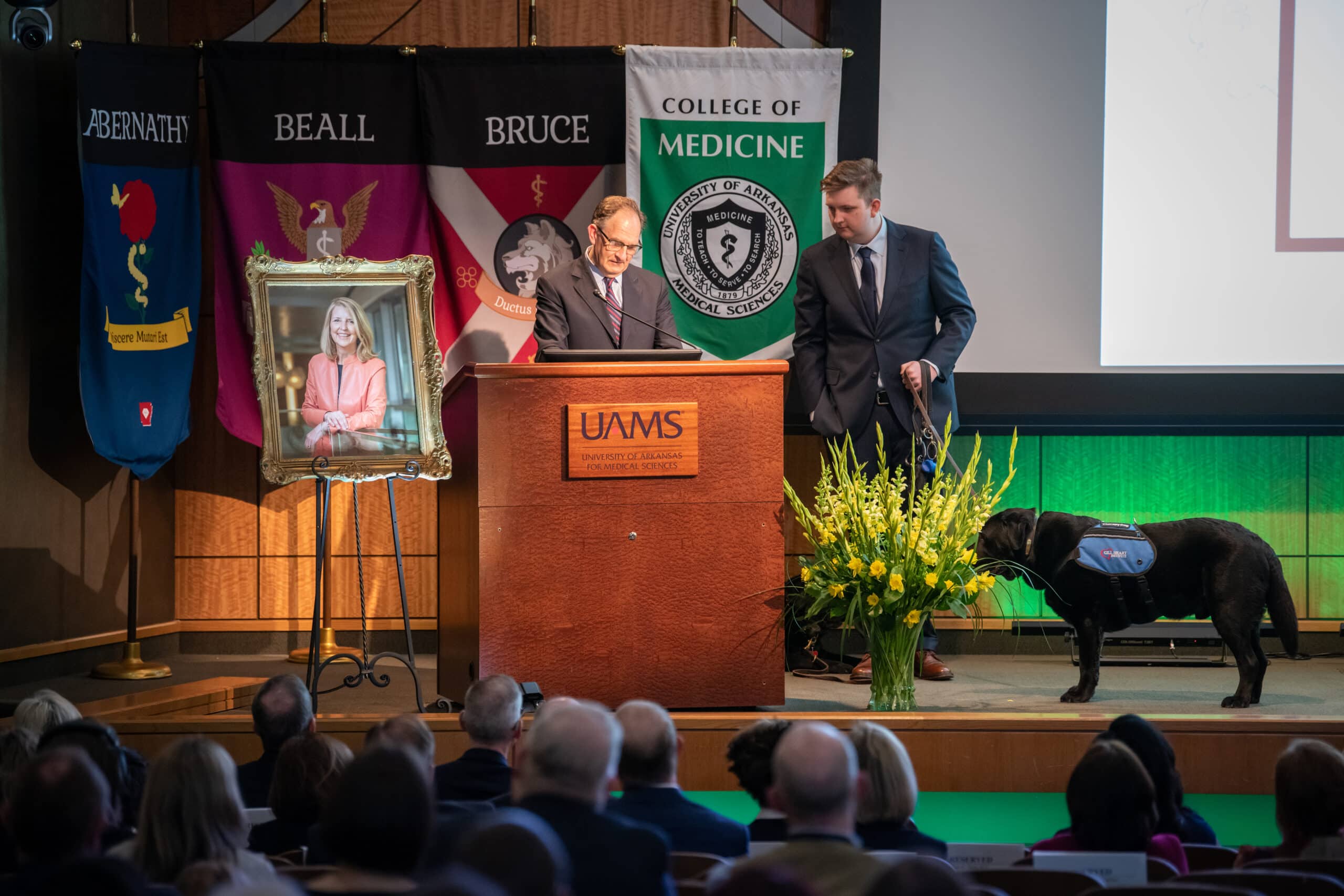
About 120 people and two dogs gathered Feb. 9 in the Fred Smith Auditorium to participate in a live-streamed celebration of the life of Susan Smyth, M.D., Ph.D., who was the executive vice chancellor at the University of Arkansas for Medical Sciences (UAMS) and dean of the UAMS College of Medicine.

Smyth, who joined UAMS in June 2021, died Dec. 31, 2022.

The dogs, English black Labradors Saleh and Carmine, were former therapy dogs at the University of Kentucky that Smyth adopted as pets. Wearing service dog vests and on leashes, they were escorted into the auditorium and onto the stage by Smyth’s husband, Andrew J. Morris, Ph.D., and the oldest of the couple’s two sons, Edward.

https://news.uams.edu/2023/02/14/uams-celebrates-life-of-susan-smyth-m-d-ph-d/

I³R, UAMS and Health Tech Industry Collaborate to Deliver Innovation for Impact

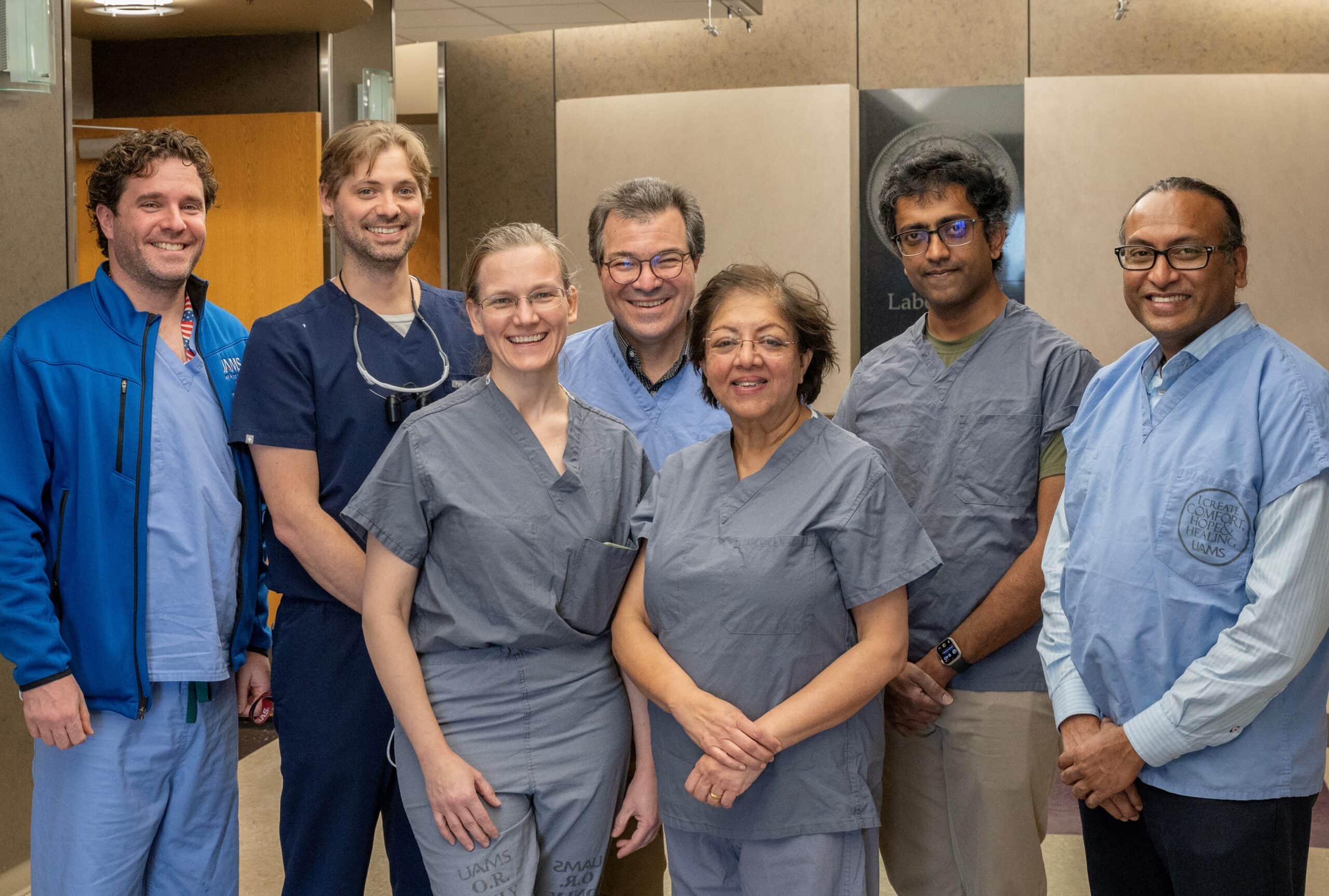
FAYETTEVILLE, Ark. – The Institute for Integrative and Innovative Research (I³R) at the University of Arkansas is collaborating with the University of Arkansas for Medical Sciences (UAMS) and health technology companies and providers on a groundbreaking neural-enhanced prosthesis study, one that has the potential to deliver meaningful sensations of touch, grip force and hand opening to users.

James Abbas, Ph.D., who is co-directing the study, led discussions that have brought a team of UAMS surgeons, Snell Prosthetics and Orthotics and health technology companies together with I³R’s Adaptive Neural Systems Group (ANS).

“Innovation in health care requires coordination and integration across disciplines and sectors. We are thrilled to have established partnerships with UAMS and Snell to innovate here in Arkansas,” said Abbas, professor of biomedical engineering and member of the ANS Group. “The world-class surgeons at UAMS will help I³R extend the reach of integrative health throughout the state and beyond, and will enhance our ability to develop and deploy breakthrough neural technology to the benefit of many people.”

https://news.uams.edu/2023/02/13/i%c2%b3r-uams-and-health-tech-industry-collaborate-to-deliver-innovation-for-impact/

Crop science M.S. student places second in international yield prediction contest

By Robby Edwards, director of communications
Dale Bumpers College of Agricultural, Food and Life Sciences

FAYETTEVILLE, Ark. — Igor Fernandes, a master's degree student in crop, soil and environmental sciences in the University of Arkansas’ Dale Bumpers College of Agricultural, Food and Life Sciences, recently placed second in an international prediction contest conducted by the Genomes to Fields Initiative.

CORN SEER — Igor Fernandes is a master's degree student in crop, soil and environmental sciences from Brazil. His adviser is Sam Fernandes, assistant professor in the Agricultural Statistics Laboratory. (Photo submitted)

The initiative, a public-private partnership also called G2F, collected data on more than 180,000 corn field plots, including 2,500 hybrids and 162 unique environments. Competitors developed prediction models to predict maize yield based on genetic and environmental data from trials, datasets and other publicly available information. From Nov. 15-Dec. 15, contestants had access to training data, and they had to submit their predictions by Jan. 15.

The Genotype by Environment contest was open to teams and individuals, and Fernandes developed his model individually. He is now working with his adviser, Sam Fernandes, assistant professor of agricultural statistics and quantitative genetics, to improve his prediction model.

Fernandes is a researcher with the Agricultural Statistics Laboratory, a program of the Arkansas Agricultural Experiment Station, the research arm of the U of A System Division of Agriculture. His research ties into work with the departments of crop, soil and environmental sciences and horticulture.

A team from Corteva Agriscience won the contest and $4,000 prize with a Mean Root Mean Square Error score of 2.328863. Fernandes was second among 33 entries with a score of 2.345147. For this contest and this RMSE metric, lower scores are better. Models with a lower RSME mean the predicted maize yield is more similar to the actual yield when compared to another model with a larger RMSE.

"We used trial data from 2014 to 2021 to build the prediction models and had to evaluate the predictions on unseen trials from 2022," Fernandes says. "We had to make predictions for different environments and different maize hybrids. My solution consisted in creating meaningful predictor variables, the so-called feature engineering process, and building a gradient boosting machine learning model with those variables."

He said his solution included using aggregations, such as calculating the mean, standard deviation and others, from time series climate variables to summarize climate patterns for each season in each environment.

"Another useful technique used was the adoption of lagged variables, which means that we take a variable and look at its pattern in a previous window, which could be from the previous year or the previous two years, and use it as a predictor," Fernandes says. 

More about the Agricultural Statistics Laboratory here.

Genomes to Fields focuses on efficiently and sustainably producing a safe, dependable food supply for a growing world population, which requires the development and management of crop varieties that will perform well in spite of increased weather variability. A widescale plant phenotyping initiative is proposed, which will expand understanding of the interacting roles of crop genomes and crop environments (including weather and management practices) on crop performance. By improving the ability to predict crop performance in diverse environments, the initiative will enhance capabilities to develop new varieties and manage the effects of weather variability on crop productivity.

To learn more about Division of Agriculture research, visit the Arkansas Agricultural Experiment Station website: https://aaes.uada.edu/. Follow us on Twitter at @ArkAgResearch and on Instagram at @ArkAgResearch. To learn more about the Division of Agriculture, visit https://uada.edu/. Follow us on Twitter at @AgInArk.

Teaching method increases students’ interest in programming and breadboarding

By Brittaney Mann
U of A System Division of Agriculture

FAYETTEVILLE, Ark. — Researchers validated a curriculum development model that increased the confidence and interest of beginning agricultural students learning how to breadboard and program Arduino UNOs.

LEARN BY DOING — Don Johnson, University Professor of agricultural education, communications and technology, conducted research to validate a curriculum method using Arduino UNO microcontroller breadboard to build students' confidence in learning by breaking down complex tasks into smaller components. (U of A System Division of Agriculture photo by Fred Miller)

After conducting a two-phase test at two universities, the results of the study found that breaking larger, more complex tasks into smaller, more manageable components enhanced student interest, confidence, skills and knowledge.

Don Johnson, University Professor of agricultural education, communications and technology and principal investigator on the project, said that when students are successful with smaller individual tasks, they have higher self-efficacy, or confidence, and an increase in interest.

“This also helps students better manage the cognitive load associated with learning about unfamiliar material and provides more and better opportunities for student success, which contributes to increased self-efficacy” he said.

Johnson and the other researchers tested self-efficacy theory using a program evaluation model that allowed them to evaluate and retest the method to make necessary improvements.

Johnson said the research team chose to study novice students’ learning about Arduino UNOs, a type of microcontroller, because of its prominence in many levels of education and the widespread use of microcontrollers as embedded computing systems in many agricultural technologies, like tractors and irrigation systems.

Johnson conducts research on human capital development and agricultural technologies for the Arkansas Agricultural Experiment Station, the research arm of the University of Arkansas System Division of Agriculture. He teaches courses through the Dale Bumpers College of Agricultural, Food and Life Sciences at the University of Arkansas.

Testing the teaching

The researchers evaluated undergraduate students enrolled in introductory agricultural systems technology courses at the University of Arkansas and Utah State University.

He collaborated with Michael Pate, associate professor of agricultural systems technology and, agricultural safety and health at Utah State University.

The study was conducted in two phases, with a pilot test taking place during the second week of the fall 2021 semester, followed by a retest at the other university later in the semester. The students received the same presentation and completed the same assignment at both universities, where they constructed LED circuits on the same breadboards and programmed the Arduino UNOs to cause the LEDs to blink on and off in a specific order at specified intervals.

The students at the pilot test university learned about Arduino UNO through an online lesson followed by a hands-on activity.

The results from the first university indicated that the traditional approach allows students to increase their self-efficacy in the task, but the researchers wanted to see an increase in interest.

“Interest is an essential part of effective learning,” Johnson said. “You can learn content that you are not interested in, but the process is neither efficient nor enjoyable.”

He also noted that students who develop interest in a topic are more likely to continue learning about the topic outside the classroom.

Based on the pilot test results, the researchers modified the teaching method with self-efficacy theory in mind. They conducted the initial lesson in a face-to-face format and integrated four hands-on practice tasks within the lesson.

With this method, the students were more engaged with their work and showed an increase in breadboarding and programming self-efficacy, interest in learning about Arduino UNO and knowledge in Arduino UNO.

Integrating the practice tasks into the lesson allowed students to make a connection between the lesson and hands-on application in breadboarding and programming, Johnson said. It also helped reduce the cognitive load while only adding about 10 minutes to the lesson.

“Professors should consider breaking big tasks into smaller, logically sequenced tasks, and then provide students with opportunities to achieve success with these smaller tasks as they build toward higher level applications,” Johnson said.

Students were proud of their work during this project, and many recorded their accomplishments on their phones, Johnson said.

In addition to Johnson and Pate, other members of the research team included Christopher Estepp, associate professor of agricultural education, communications and technology; George Wardlow, head of the agricultural education, communications and technology department; and Grant Hood, a University of Arkansas 2022 graduate who received his master’s in Agricultural and Extension Education after completing part of this project for his thesis.

The American Society of Agricultural and Biological Engineers recently published the research.

Johnson replicated the teaching method during the fall 2022 semester and found the revised instructional treatment once again resulted in statistically significant and large increases in student interest, self-efficacy, and knowledge.

To learn more about Division of Agriculture research, visit the Arkansas Agricultural Experiment Station website: https://aaes.uada.edu/. Follow us on Twitter at @ArkAgResearch. To learn more about the Division of Agriculture, visit https://uada.edu/. Follow us on Twitter at @AgInArk.

High input prices, drought, disease cause Arkansas cattle farmers to struggle

by George Jared (gjared@talkbusiness.net)

Cattle farmer John Kunkel spent much of his professional career as a buyer for Walmart. He decided in 2014 to return to his childhood home in Evening Shade, a small town in Sharp County. He wanted to raise cattle.

He returned home to run his family farm, Peaceful River Farm, located along the Strawberry River. It’s been in their family for more than a century.

He began with a herd of 14 head and has been able to grow it to about 50 head. An input cost explosion at the beginning of 2022 coupled with a drought that impacted hay production means many small cattle operations are struggling to survive, Kunkel told Talk Business & Politics.

https://talkbusiness.net/2023/02/high-input-prices-drought-disease-cause-arkansas-cattle-farmers-to-struggle/